


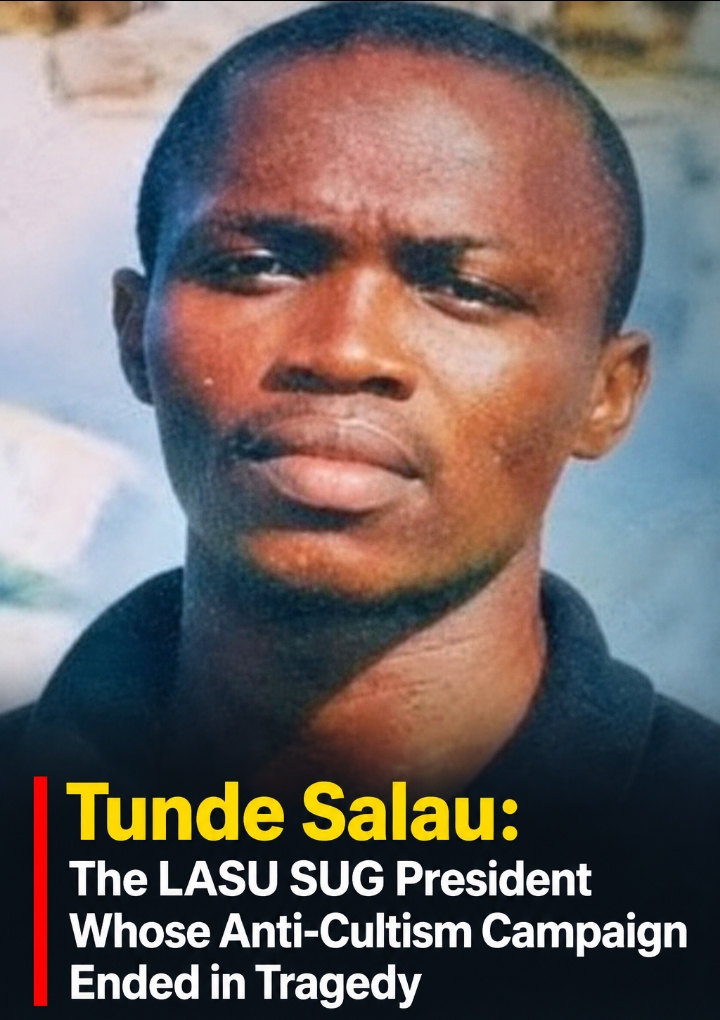
More than two decades after the death of Lagos State University Students’ Union President, Comrade Tunde Salau, conflicting recollections about his leadership, his campaign against cultism and the circumstances surrounding his death continue to generate debate.
What is firmly established is that Salau was the president of the Lagos State University student’s Union and was killed on February 13 2002, after leaving an examination at the university.
A contemporary report published by SAPA/AFP the following day said the student leader was attacked with machetes by unknown assailants shortly after appearing for an examination. He sustained severe injuries and died. The report said the motive for the killing was not immediately known.
Years later, accounts from former LASU students and student activists continued to describe Salau’s tenure as one marked by a determined campaign against cultism on campus.
A 2012 account on the history of LASU’s Students’ Union described the Salau administration’s fight against cultism as one of the union’s most notable anti-cultism campaigns and recorded his death on February 13, 2002.
However, the historical record becomes considerably more disputed when it comes to the events that allegedly preceded his death.
Some former students who have spoken about the period maintain that Salau was a courageous, intelligent and popular student leader who confronted the cult menace because of the danger it posed to students and the university community.
Others have alleged that the anti-cultism campaign was selective and that particular confraternities were disproportionately targeted. Some commentators have further alleged that Salau himself had links to a confraternity.
These claims remain disputed and could not be independently established from the reliable historical sources reviewed for this report. They should therefore not be treated as established facts.
There are also competing recollections about the deaths of students identified in later accounts as Ralph and Gatsby and the extent to which those incidents were connected to Salau’s administration. While some former students have described the incidents as part of the violent cult clashes that characterised the period, available contemporary reporting does not provide sufficient evidence to conclusively establish all the details now circulating online.
What is not in dispute is that LASU was experiencing serious problems involving cult-related violence during the period.
One historical account on violence in Nigerian schools records the murder of the LASU Students’ Union President on February 13 and describes him as having been publicly attacked and fatally wounded after emerging from an examination.
The tragedy therefore remains part of the painful history of campus violence and cultism in Nigeria.
For many former LASU students, Tunde Salau remains a symbol of student activism and courage. For others, his story is a cautionary tale about the dangers of confronting violent organisations outside the protection of established security and judicial institutions.
Perhaps the most important lesson from his story is that cultism cannot be defeated by replacing one form of violence with another.
The responsibility for combating cultism belongs to university authorities, law-enforcement agencies, government and the wider society. Students can provide information and advocate for safer campuses, but violence, jungle justice and extrajudicial punishment cannot provide a lasting solution.
More than 20 years after Salau’s death, the circumstances surrounding his leadership and killing continue to attract debate among former LASU students.
But one fact remains clear: a young student leader lost his life in the midst of a violent period in the history of the university.
His story should therefore be remembered not to glorify violence or any cult organisation, but to remind present and future generations of the devastating consequences of cultism, reprisal attacks and unchecked violence on Nigerian campuses.
This report does not establish allegations of cult membership or involvement in unlawful killings against any individual without independently verifiable evidence. Accounts attributed to former students are presented as recollections and allegations, not established facts.