


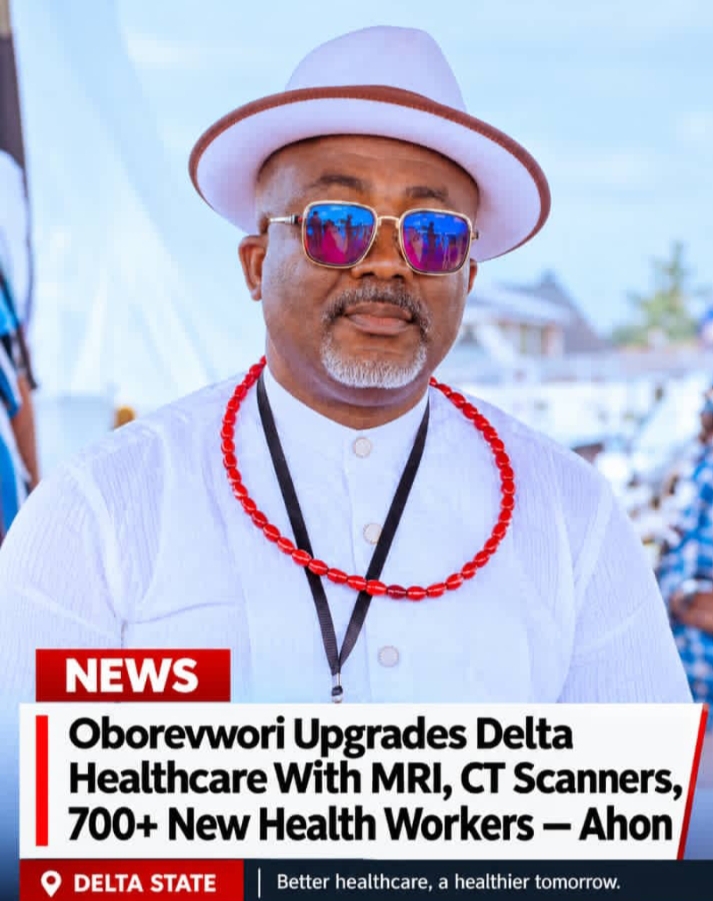
The Delta State Government has intensified efforts to strengthen healthcare delivery across the state through the acquisition of advanced medical equipment and the recruitment of more than 700 healthcare personnel.
Chief Press Secretary to Governor Sheriff Oborevwori, Sir Festus Ahon, disclosed this during an interview on Independent Radio FM 92.3, Benin, where he highlighted the administration’s interventions in the health sector.
Ahon said the government had invested in modern diagnostic equipment, including Magnetic Resonance Imaging (MRI) machines, CT scanners and 4D ultrasound machines, as part of measures to expand access to specialised healthcare within the state.
According to him, Delta has procured three 1.5 Tesla helium-free MRI machines, with facilities designated for Asaba Specialist Hospital, Central Hospital, Warri, and Delta State University Teaching Hospital (DELSUTH), Oghara.
He said the administration had also provided CT scan machines and other modern radiology and laboratory equipment to improve diagnostic services in major hospitals.
Ahon further disclosed that eight dialysis machines had been procured and distributed among major healthcare facilities in Asaba, Warri and Oghara, while 25 units of 4D ultrasound scanners were distributed across general hospitals in the state.
The Chief Press Secretary said the interventions were designed to reduce the need for residents to travel outside Delta State or abroad to access specialised diagnostic and medical services.
On healthcare access, Ahon said the state government had sustained free medical treatment for children between zero and five years while expanding the Delta State Contributory Health Scheme to reach more residents.
He also stated that thousands of vulnerable residents, including widows, had benefited from the state’s healthcare and welfare programmes.
On manpower, Ahon said Governor Oborevwori had approved the recruitment of more than 700 medical and non-medical personnel to strengthen staffing in public health institutions.
The recruitment approval was also publicly announced by the Delta State Commissioner for Health, Dr Joseph Onojaeme, in March 2026, with the government saying the exercise was necessary to address growing demand and manpower gaps in the health sector.
Ahon said the governor had further directed that healthcare workers who leave the state service should be replaced promptly to prevent manpower shortages from affecting service delivery.
He added that the administration had introduced additional financial incentives for healthcare professionals, including special allowances for doctors and health officers, as part of measures to improve staff retention.
The Chief Press Secretary also highlighted the establishment of the College of Health Technology at Ovrode in Isoko North Local Government Area and the development of medical education infrastructure in the state.
The healthcare investments are part of the Oborevwori administration’s broader efforts under the M.O.R.E. Agenda to improve medical infrastructure, expand access to healthcare and strengthen the state’s healthcare workforce.
Recent state budget documents and reports have similarly listed the procurement of CT scanners, dialysis equipment and three MRI machines among the administration’s health-sector interventions.