


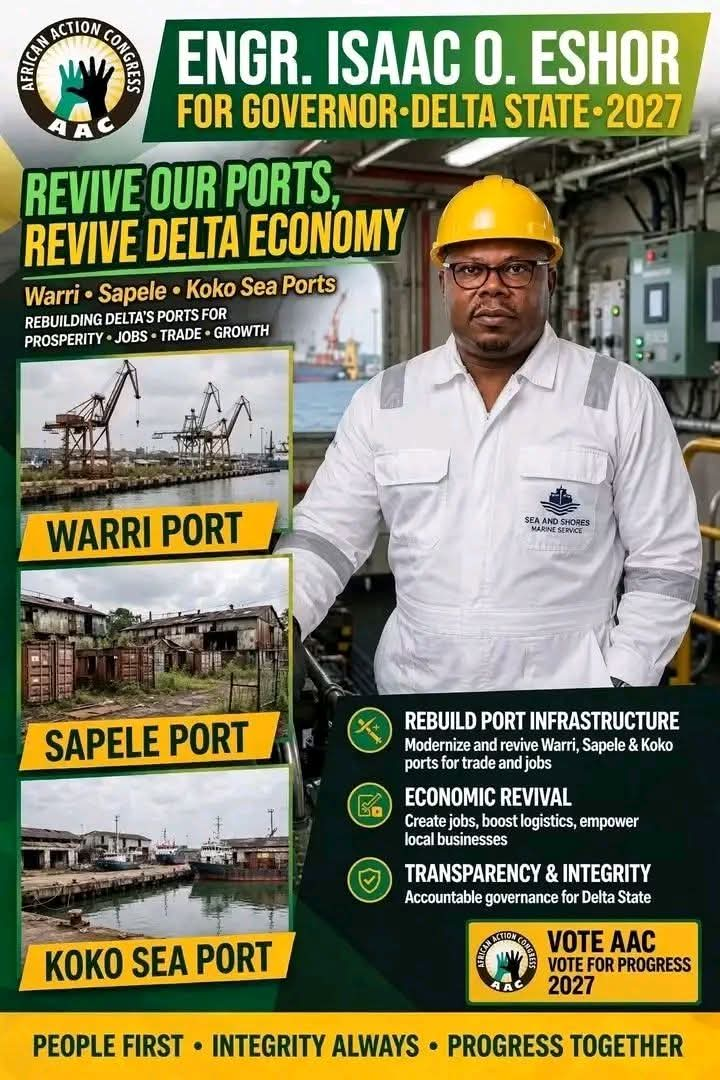
ASABA, Delta State — African Action Congress (AAC) governorship candidate, Engr. Isaac Eshor, has proposed developing Delta State’s four major ports in Warri, Koko, Sapele and Burutu to position the state as a leading hub for Nigeria’s blue economy and create employment opportunities for young people.
Eshor criticised what he described as a lack of visionary leadership in the state, arguing that its maritime resources remain underutilised despite their potential to attract investment, stimulate economic growth and generate thousands of jobs.
According to him, strategic investment in port infrastructure, ship repairs and maritime services could strengthen Delta’s economy while reducing Nigeria’s dependence on foreign shipyards.
Eshor Advocates Ship-Repair and Dry-Docking Facilities
The AAC candidate called for the establishment of ship-repair and dry-docking facilities in Delta State, saying the initiative would enable Nigerian shipowners to maintain their vessels locally rather than sending them abroad.
“Every ship that leaves Nigeria for repairs takes a Nigerian job with it,” Eshor said.
He explained that ship maintenance abroad involves substantial expenditure, citing estimates of between $300,000 and $500,000 for a single dry-docking operation, while towing a vessel to Singapore could reportedly add as much as $1.8 million in expenses.
Eshor argued that retaining such activities within Nigeria would create opportunities for welders, marine engineers, electricians, painters and other skilled professionals.
He also identified Burutu, whose port activity reportedly declined after the Nigerian Civil War, as an important part of Delta’s maritime development potential.
Maritime Development Could Create Jobs for Youths
Eshor said functional dry docks could provide employment across several industries while creating opportunities for technical education and skills development.
He proposed partnerships with polytechnics to provide practical training for students in marine engineering and related fields.
He added that improved maritime infrastructure could benefit fishing operators, support the maintenance of government boats and security patrol vessels, and encourage the growth of businesses linked to the waterways.
The AAC candidate also advocated the development of waterfronts into commercial and recreational centres featuring tourism facilities, boat clubs, mini-dockyards and community jetties where boats could be maintained.
According to him, these investments could stimulate local commerce and generate additional revenue for the state through taxes, commercial leases and other maritime-related activities.
Eshor Cites Employment Potential of Maritime Industry
To illustrate the sector’s employment potential, Eshor cited Nigerdock, saying the company had repaired more than 600 vessels and employed over 1,500 people by 2001.
He also referred to the Federal Government’s stated ambition to create five million ocean-related jobs by 2035, arguing that Delta State should develop the infrastructure and investment framework needed to benefit from emerging opportunities.
However, the figures and the current status of the cited employment target would require independent verification.
Candidate Proposes Private-Sector Investment
On financing, Eshor advocated private-sector participation supported by transparent lease agreements and arrangements that would prioritise employment for Delta residents.
He maintained that attracting maritime investors would require a coordinated development plan capable of connecting the state’s waterways, skilled workforce and young population to sustainable economic opportunities.
“When those jobs come, will Delta be ready, or will we watch them sail past?” he asked.
PEshor argued that Delta’s challenge was not a shortage of waterways, skills or young people, but the absence of a coordinated strategy to harness these resources for economic development.
“Delta does not lack water, skills or young people. It lacks a plan that connects them. I will build it,” he said.
The AAC governorship candidate assured Deltans that, if elected, he would prioritise maritime development and work towards transforming the state into a major hub for Nigeria’s blue economy, with job creation for young people as a central objective.